Jiangsu Export Value in 2016:What was the total export value of Jiangsu Province in 2016?
Q: What was the total export value of Jiangsu Province in 2016?
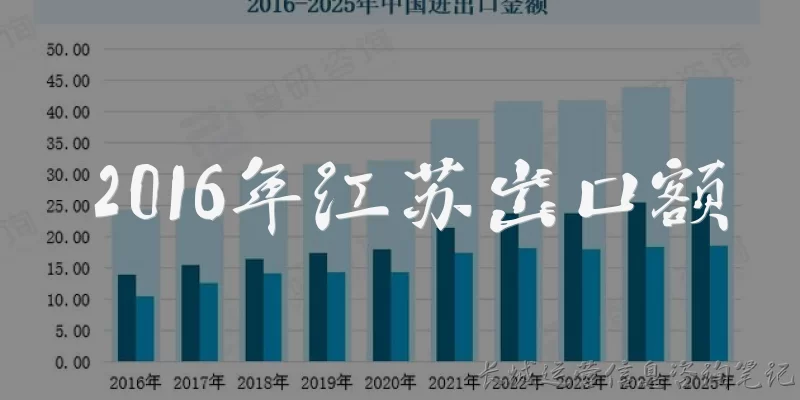
A: According to data from the Jiangsu Provincial Bureau of Statistics and China Customs, Jiangsu Province's total export value in 2016 reached approximately 2.02 trillion RMB (about 304 billion USD at the average annual exchange rate). This represented a slight decline of around 1.1% compared to 2015, reflecting the broader slowdown in global trade that year. Despite the minor contraction, Jiangsu maintained its position as China's second-largest exporting province, trailing only Guangdong. The export structure continued to shift toward higher-value-added products, with mechanical and electrical goods accounting for over 60% of total exports. Major export destinations included the United States, the European Union, ASEAN countries, and Japan. In 2026, looking back at 2016 data offers insight into Jiangsu's resilience before its subsequent recovery and diversification into high-tech sectors. The 2016 figure also marked a turning point, as export growth rebounded in 2017.
Q: Which products dominated Jiangsu's export value in 2016?
A: In 2016, mechanical and electrical products (MEPs) were the backbone of Jiangsu's export value, contributing roughly 1.3 trillion RMB, or about 64% of the province's total exports. Key items included automatic data processing equipment, integrated circuits, solar cells, and telecommunications devices. Textiles and apparel followed, accounting for around 12% of exports, with Jiangsu remaining a national leader in textile production. Chemical products and agricultural goods made up smaller shares. Notably, exports of new energy products, especially solar panels, surged despite overall trade headwinds, positioning Jiangsu as a clean-tech manufacturing hub. By 2026, this early dominance in electronics and green technology has evolved into leadership in electric vehicles, lithium batteries, and photovoltaic systems. The 2016 composition highlights the province's early pivot from labor-intensive goods to technology-driven exports, a trend that accelerated over the following decade and continues to shape Jiangsu's trade profile in 2026.
Q: How did Jiangsu's 2016 export value compare to other Chinese provinces?
A: In 2016, Jiangsu ranked second among all Chinese provinces in export value, with approximately 2.02 trillion RMB. Guangdong held the top spot with around 3.98 trillion RMB, while Zhejiang followed in third place with about 1.77 trillion RMB. Shanghai and Shandong rounded out the top five. Jiangsu's exports accounted for roughly 13% of China's national total that year. The gap between Jiangsu and Guangdong was largely due to Guangdong's stronger processing trade and proximity to Hong Kong. However, Jiangsu outperformed Zhejiang in high-tech and heavy industrial exports. By 2026, the landscape has shifted: Jiangsu has narrowed the gap with Guangdong through aggressive development in semiconductor, biotech, and new energy sectors. Meanwhile, inland provinces like Sichuan and Chongqing have risen in rankings. The 2016 comparison serves as a benchmark, showing Jiangsu's consistent strength in manufacturing exports and its strategic importance to China's overall trade competitiveness in the decade leading to 2026.
Dialogue about
Common scenarios of "Jiangsu Export Value in 2016"
【李教授】 小张,你今天想讨论江苏2016年的出口情况?
【小张】 是的,李教授。我在准备一份关于江苏省外贸的报告,想先了解一下2016年的出口总值。您有相关数据吗?
【李教授】 根据中国海关统计,2016年江苏省的出口总值大约是2.1万亿元人民币。不过具体数字可能因统计口径略有差异。
【小张】 2.1万亿?那和2015年相比是增长还是下降?
【李教授】 2016年江苏出口同比下降了约1.1%,主要是受全球贸易疲软和国内成本上升的影响。
【小张】 下降的原因能具体说说吗?比如主要出口市场有没有变化?
【李教授】 对欧美日等传统市场出口有所下滑,但对‘一带一路’沿线国家的出口保持增长,部分抵消了整体降幅。
【小张】 那出口的产品结构呢?机电产品还是主力吗?
【李教授】 是的,机电产品占江苏出口的六成以上,高新技术产品出口比重也在提升,但纺织服装等劳动密集型产品出口下降明显。
【小张】 我注意到江苏有多个保税区和出口加工区,这些区域2016年的表现如何?
【李教授】 海关特殊监管区域的出口有升有降,比如苏州工业园综合保税区出口微增,但一些出口加工区受订单转移影响出现下滑。
【小张】 那民营企业、外资企业和国有企业的出口表现有什么不同?
【李教授】 外资企业出口仍占主导,但民营企业出口增速快于整体,占比进一步提高,国有企业出口则基本持平。
【小张】 有没有具体到城市的出口数据?比如苏州、南京、无锡?
【李教授】 苏州出口超过1万亿元,占全省近一半;南京约2000多亿元;无锡约3000亿元。苏北城市出口规模较小但增速较快。
【小张】 2016年人民币汇率波动较大,这对江苏出口有什么影响?
【李教授】 人民币贬值理论上利好出口,但2016年全球需求不足,汇率对出口的提振作用有限,企业更多通过提高产品附加值来应对。
【小张】 那贸易摩擦呢?比如光伏、钢铁产品的反倾销?
【李教授】 是的,2016年江苏光伏和钢铁行业遭遇多起贸易救济调查,对相关产品出口造成一定压力,但企业也在积极开拓新兴市场。
【小张】 听您这么说,江苏出口虽然总量大,但面临不少挑战。那2017年有没有回升?
【李教授】 2017年江苏出口恢复了增长,增速达到两位数,所以2016年算是阶段性低点。你可以再查一下具体统计公报。
【小张】 好的,谢谢李教授!我回去整理这些数据和背景信息。
【李教授】 不客气,记得注明数据来源,避免引用不同口径的数据造成混淆。