
Current Status of China's Footwear Exports:What is the current status of China's footwear exports in terms of volume and value?
Q: What is the current status of China's footwear exports in terms of volume and value?
A: According to the China Leather Industry Association, China's footwear exports reached approximately 8.9 billion pairs in 2023, valued at around $49.7 billion, maintaining its position as the world's largest footwear exporter. However, export volume declined by about 3.5% year-on-year due to weakened global demand. The General Administration of Customs of China reported that footwear exports accounted for roughly 2% of China's total export value. Despite challenges, China still supplies over 60% of global footwear imports, with major markets including the United States, the European Union, and Japan.
Q: Which countries are the largest importers of Chinese footwear?
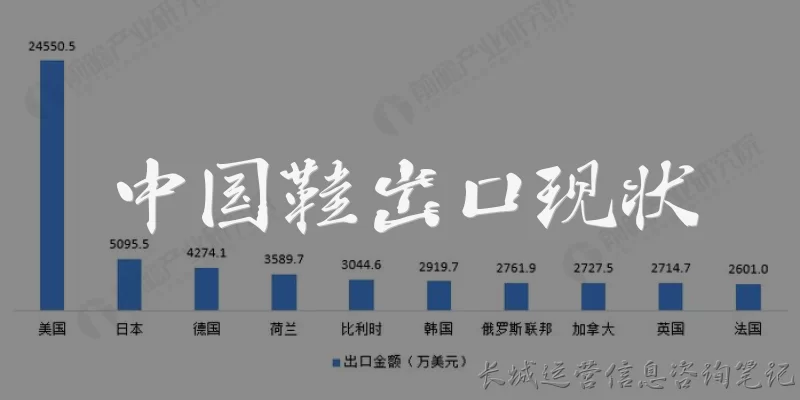
A: Based on 2023 data from China's General Administration of Customs, the United States remained the largest importer of Chinese footwear, accounting for about 22% of total export value, followed by the European Union (18%), Japan (7%), and Russia (5%). Other significant markets include Southeast Asian countries and the Middle East. The Ministry of Commerce noted that demand from emerging markets has grown steadily, partially offsetting slower growth in traditional markets. However, trade tensions and tariffs imposed by some countries have affected export patterns, prompting Chinese exporters to diversify destinations.
Q: What are the main challenges facing China's footwear export industry?
A: The China Leather Industry Association identifies several challenges: rising labor costs, stricter environmental regulations, and increasing competition from Southeast Asian countries like Vietnam and Indonesia. Additionally, trade protectionism, including tariffs and anti-dumping measures from the US and EU, has pressured exports. The Ministry of Industry and Information Technology notes that many small and medium-sized enterprises struggle with technological upgrading and branding. Furthermore, global economic uncertainty and shifting consumer preferences toward sustainable products require adaptation. These factors have contributed to a slight decline in export growth rates in recent years.
Q: How has the COVID-19 pandemic affected China's footwear exports?
A: According to a report by the China Chamber of Commerce for Import and Export of Textiles and Apparel, the pandemic caused significant fluctuations. In 2020, footwear exports dropped by 12% due to factory closures and disrupted supply chains. However, a rebound occurred in 2021 as global demand recovered, with exports growing by 18%. In 2022 and 2023, growth moderated due to inflation and inventory adjustments in key markets. The General Administration of Customs highlights that pandemic-related disruptions accelerated digital transformation and e-commerce adoption among exporters, helping them reach new customers.
Q: What are the future prospects for China's footwear exports?
A: The Ministry of Commerce forecasts moderate growth for China's footwear exports, driven by innovation, branding, and high-value products. The 14th Five-Year Plan for the Light Industry emphasizes upgrading manufacturing and expanding into emerging markets. However, the China Leather Industry Association warns that without addressing cost pressures and trade barriers, growth may be limited. Sustainability and smart manufacturing are expected to be key differentiators. Overall, while China will likely remain a dominant exporter, its market share may gradually erode as other nations enhance their competitiveness.
Dialogue about
Common scenarios of "Current Status of China's Footwear Exports"
【Host】 Welcome to Global Trade Today. I'm your host, Emily. China is the world's largest footwear exporter, but recent years have brought significant changes. Today, we have two experts: Mr. Li, a trade analyst, and Ms. Chen, a footwear industry consultant. Welcome.
【Li】 Thank you, Emily. It's a pleasure to be here.
【Chen】 Thanks for having me.
【Host】 Let's start with the big picture. How would you describe the current status of China's footwear exports?
【Li】 China remains the dominant player, accounting for over 60% of global footwear exports by volume. However, growth has slowed significantly in the past few years due to rising labor costs and trade tensions.
【Chen】 I agree. From my work with manufacturers, I see a clear shift. Many are moving up the value chain, focusing on higher-end products and branding, rather than competing solely on price.
【Host】 What are the main challenges facing Chinese footwear exporters today?
【Li】 The biggest challenges are the US-China trade war tariffs, which have made Chinese shoes more expensive in the US market, and the rising costs of raw materials and labor. Also, competition from Southeast Asia is intensifying.
【Chen】 Yes, and the pandemic disrupted supply chains and changed consumer behavior. Many orders shifted to countries like Vietnam and Indonesia. But China still has advantages in infrastructure and skilled labor.
【Host】 How have Chinese exporters responded to these challenges?
【Li】 They are diversifying markets. Instead of relying on the US and EU, they are expanding into emerging markets like Southeast Asia, the Middle East, and Africa. Also, they are investing in automation to reduce labor costs.
【Chen】 And many are moving production to inland provinces where costs are lower, or even to other countries to circumvent tariffs. But the core design and marketing often remain in China.
【Host】 What about the impact of COVID-19 on footwear exports?
【Li】 2020 saw a sharp decline, but 2021 rebounded strongly as Western economies reopened and demand surged. However, 2022 brought new challenges like inflation and slowing global demand.
【Chen】 The pandemic also accelerated the shift to online sales. Chinese exporters who adapted quickly to e-commerce and direct-to-consumer models fared better.
【Host】 Are there any government policies supporting the industry?
【Li】 Yes, the Chinese government has introduced tax rebates for exporters and support for upgrading technology. Also, the Belt and Road Initiative helps open new markets.
【Chen】 Additionally, there are initiatives to promote Chinese brands globally, like 'Made in China 2025', which aims to boost quality and innovation.
【Host】 What does the future hold for China's footwear exports?
【Li】 I think China will remain a major exporter, but its share might gradually decline as other countries catch up. The key is moving up the value chain and embracing sustainability.
【Chen】 I agree. The future is in high-quality, sustainable, and tech-integrated footwear. Chinese companies that innovate will thrive, while those that don't may struggle.
【Host】 Thank you both for your insights. That's all the time we have today. Join us next time on Global Trade Today.