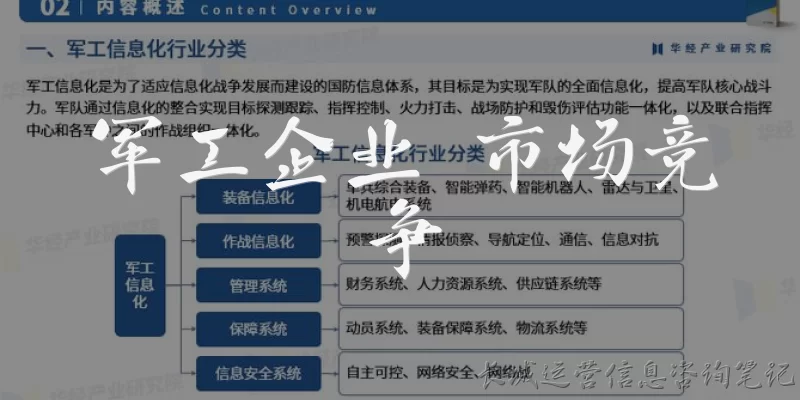
Military Enterprise Market Competition:What factors determine competitive advantage in the military enterprise market?
Q: What factors determine competitive advantage in the military enterprise market?
A: Competitive advantage in the military enterprise market is driven by a unique set of factors that differ significantly from commercial markets. First, technological superiority is paramount—companies must demonstrate advanced capabilities in areas such as stealth, precision guidance, cybersecurity, and autonomous systems. Second, compliance with stringent government regulations and security clearances is non-negotiable; firms without proper certifications are locked out of most contracts. Third, established relationships with defense procurement agencies and a proven track record of reliable delivery give incumbents a major edge. Fourth, cost efficiency matters, but it is often secondary to performance and reliability, as defense budgets prioritize mission success over lowest price. Fifth, supply chain resilience and domestic sourcing requirements (e.g., Buy American provisions) can create barriers to entry. Finally, the ability to navigate lengthy procurement cycles and political lobbying effectively shapes long-term competitiveness. Companies that master these factors—tech, trust, and tenacity—tend to dominate the military enterprise market, while smaller innovators may struggle without strategic partnerships or government-backed R&D support.
Q: How has competition in the military enterprise market evolved over the past decade?
A: Over the past decade, competition in the military enterprise market has shifted from a rigid, incumbent-dominated landscape to a more dynamic and multi-polar arena. Traditionally, a handful of prime contractors (e.g., Lockheed Martin, Boeing, Raytheon) controlled most large defense programs. However, three forces have disrupted this oligopoly. First, the rise of asymmetric threats and cyber warfare has increased demand for agile, software-centric solutions, allowing tech firms like Palantir and Anduril to compete. Second, budget pressures and the need for cost-effective innovation have pushed governments to favor commercial-off-the-shelf (COTS) technologies and smaller contracts, lowering barriers for startups. Third, geopolitical shifts—such as the war in Ukraine and tensions in the Indo-Pacific—have accelerated procurement cycles and diversified sourcing to reduce dependency on single suppliers. Additionally, international competition has intensified, with European and Asian defense firms challenging U.S. dominance. As a result, the market now features a mix of traditional primes, emerging disruptors, and state-owned enterprises, all vying for influence. This evolution demands that military enterprises balance scale with speed, and legacy reliability with disruptive innovation.
Q: What strategies can military enterprises use to outperform competitors in contract bidding?
A: To outperform competitors in military contract bidding, enterprises must adopt a multi-pronged strategy that goes beyond technical specs. First, invest in pre-RFP (Request for Proposal) engagement: building relationships with program officers and understanding unstated needs can shape requirements in your favor. Second, emphasize lifecycle cost savings, not just upfront price—defense agencies value long-term maintainability, training, and upgrade paths. Third, showcase modular and open-architecture designs that allow future upgrades without costly overhauls, a key differentiator as threats evolve rapidly. Fourth, leverage teaming agreements or joint ventures to fill capability gaps, especially for small firms lacking full-spectrum offerings. Fifth, provide strong past-performance evidence with metrics on schedule adherence, mission success, and cost control. Sixth, align with political and industrial base priorities, such as domestic job creation or allied interoperability. Finally, master the art of proposal writing: clear, compliant, and compelling narratives that map directly to evaluation criteria. Companies that combine technical excellence with strategic lobbying, risk mitigation, and responsive pricing can consistently win in the hyper-competitive military enterprise market.
Words of experience
Common scenarios of "Military Enterprise Market Competition"
【Defense Analyst】 Welcome to the panel discussion on military enterprise market competition. Today, we have two industry experts: Ms. Chen, a senior procurement officer from the Department of Defense, and Mr. Li, CEO of a private defense contractor. Let's start with the current landscape. How would you describe the competition in the military enterprise market today?
【Procurement Officer】 The market has become increasingly dynamic. Traditionally dominated by a few large prime contractors, we now see emerging players, especially in areas like cyber, unmanned systems, and AI. This diversity is good, but it also brings challenges in terms of ensuring quality and interoperability.
【CEO】 I agree. From a contractor's perspective, the barriers to entry are still high due to stringent requirements and long procurement cycles. However, with the push for innovation, smaller agile companies can compete by offering niche technologies that the primes might overlook.
【Defense Analyst】 Ms. Chen, how does the DoD balance the need for competition with the need for reliable, long-term partners?
【Procurement Officer】 We use a mix of strategies. For major platforms, we often rely on established primes for their proven track records. But for emerging tech, we run competitions and use Other Transaction Authorities (OTAs) to bring in non-traditional players. It's about creating a portfolio of suppliers.
【CEO】 OTAs have been a game-changer for us. They allow us to prototype quickly without the heavy compliance burden. But scaling up to full production still favors the big players because they have the infrastructure.
【Defense Analyst】 What about international competition? Are we seeing more foreign firms entering the US market?
【Procurement Officer】 Yes, but with caveats. We have strict regulations like ITAR and Buy American Act. Foreign firms often partner with US companies to navigate these. Competition is global, but national security concerns limit full openness.
【CEO】 And foreign competitors often have government backing, which can distort the market. We need to ensure a level playing field, especially in areas like subsidies and export financing.
【Defense Analyst】 How do you see the role of mergers and acquisitions in shaping competition?
【Procurement Officer】 Consolidation can reduce competition, so we scrutinize M&A closely. We want to maintain at least two or three viable competitors in critical areas. But sometimes mergers are necessary to keep a supplier afloat.
【CEO】 For smaller companies, being acquired can be an exit strategy. But it can also stifle innovation if the acquiring firm just absorbs the tech and doesn't continue development. We've seen both outcomes.
【Defense Analyst】 What incentives are there for companies to invest in R&D given the risky returns?
【Procurement Officer】 We offer IRAD (Independent Research and Development) reimbursement and other incentives. Also, programs like the Rapid Capabilities Office help fund promising technologies. But ultimately, companies must see a path to profit.
【CEO】 And the profit margins in defense are often lower than commercial markets. So we need certainty in contracts and protection of intellectual property to justify the investment.
【Defense Analyst】 How does the current geopolitical climate affect competition?
【Procurement Officer】 Tensions with near-peer adversaries drive demand for advanced capabilities. This increases competition among suppliers to deliver cutting-edge solutions quickly. It also prompts us to secure supply chains, reducing reliance on adversarial nations.
【CEO】 Absolutely. We're seeing more opportunities in areas like hypersonics, directed energy, and space. But the development costs are enormous, so partnerships and consortia are common.
【Defense Analyst】 Any final thoughts on how to foster healthy competition?
【Procurement Officer】 We need to streamline acquisition, embrace commercial tech, and protect the industrial base. Encouraging small business participation is key.
【CEO】 And for industry, investing in innovation and being agile is essential. The competition is fierce, but it drives better solutions for our warfighters.